
Journal
Christmas Poetry Writing for Middle School: Start with One Small Detail
By Veronika Childs ·
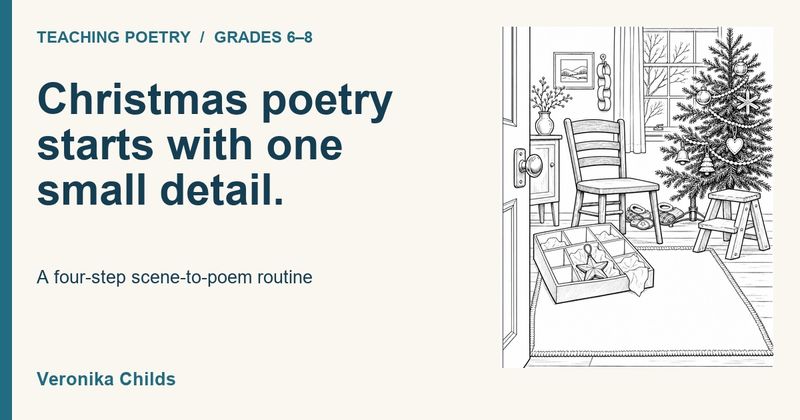
“Write a Christmas poem” can feel like a surprisingly big assignment. Students may have plenty to say about the holiday and still struggle to find a first line. A smaller invitation gives them something concrete to work with: look closely at one scene, choose one detail, and stay with a few seconds.
For grades 6–8, a shared image can make that starting point visible while leaving room for different speakers, feelings, and poems. Here is a four-step approach you can use for a Christmas poetry writing lesson.
1. Explore the scene before choosing a story
Give students a quiet minute to look. Ask them to name what they can actually see, then look again for something they missed.
In the Christmas scene for this lesson, a star ornament rests in its box, an empty chair stands beside the tree, and only a few paper links remain on the wall. Any of those details could become a starting point.
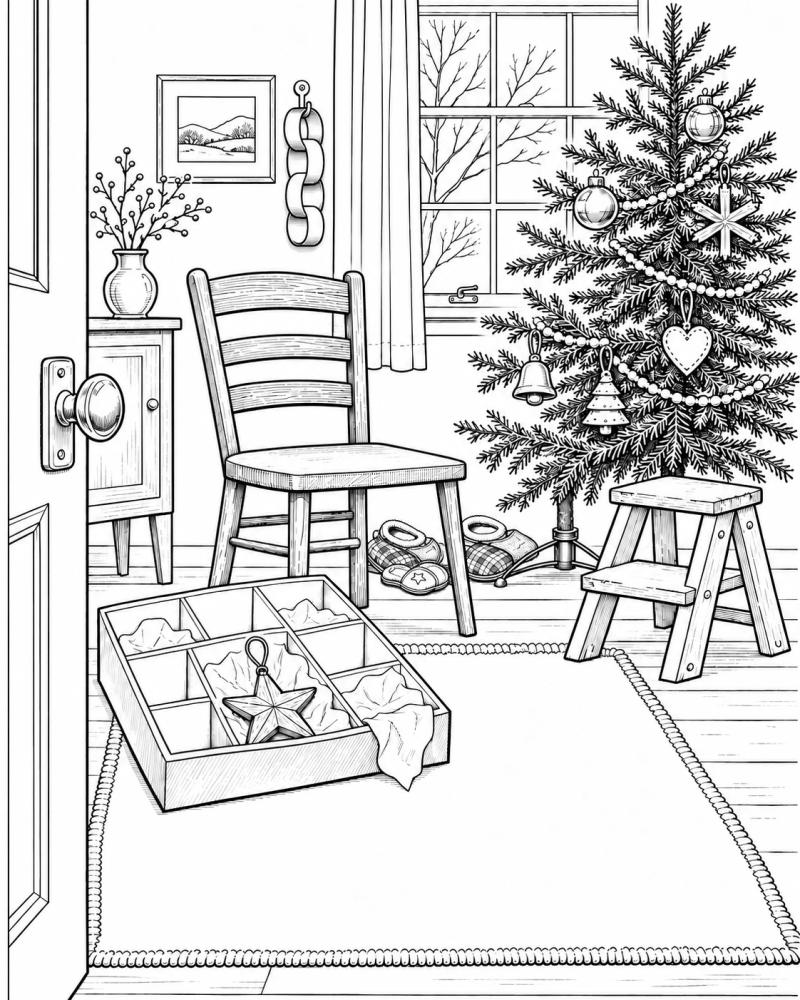
Keep observation and imagination separate. “There is a paper chain on the wall” is an observation. “Someone is counting the days until Christmas” is a possibility. Both are useful, but the second belongs to the writer’s interpretation.
Try asking: Which detail makes you wonder? Who might notice it, and why would it matter to them?
Students can invent a speaker. They do not need to share their own family traditions or memories. The same room might suggest excitement, waiting, curiosity, or loneliness; the picture does not require one correct story or a cheerful ending.
2. Build a moment around one detail
Once students choose a detail, help them narrow the time. A poem can stay with a hand reaching for a paper link or the small pause before an ornament is lifted from its box.
Ask what happens during those few seconds. What moves? What stays still? What might the speaker hear or feel?
In the completed sample journey, the writer chooses the countdown chain and develops details such as a cold floor, rough paper, and a small ripping sound. Those details belong together because they surround one action. The chain getting shorter begins to suggest the excitement of waiting.
Students do not need to use every sense. Encourage them to choose the details that help a reader enter this particular moment.
3. Build stronger lines from what is already there
Craft choices are easier to explain when students have something specific to work on. Invite them to return to their notes and try a precise verb, a comparison, or a different arrangement of words.
The sample includes this first-draft line:
My footsteps sound like drums
The writer later tries:
My footsteps beat like drums
Ask students to read both aloud. What changes when “sound” becomes “beat”? Which version better carries the speaker’s movement?
A line can also grow through precise description. The sample’s “rough paper against my thumb” keeps the reader close to the action. Students can make a strong choice without adding a comparison to every line.
4. Shape the poem and test a revision
Have students select a few of their strongest lines or phrases and arrange them into a short poem. Ask what each line adds to the same moment. A detail may need to move, combine with another, or come out.
Then make revision manageable: test one change and read both versions aloud. Students might sharpen a verb, remove an unnecessary word, or adjust a line break for a pause.
They can keep the new version or return to the earlier one. In either case, ask them to explain the effect they wanted. Revision becomes a decision they can discuss, rather than a requirement to change everything.
A ready-to-use Christmas poetry lesson
If you would like the scene and the complete progression prepared for you, my Small Moment Poetry: Christmas Edition includes four-step student pages, a completed sample journey, student reflection, teacher guidance, and a rubric for grades 6–8. The preview shows the actual lesson pages so you can see how the process fits your writers.
You can also use this approach with another shared scene. Give students something to notice twice, a moment small enough to stay with, and time to decide which words carry it best.